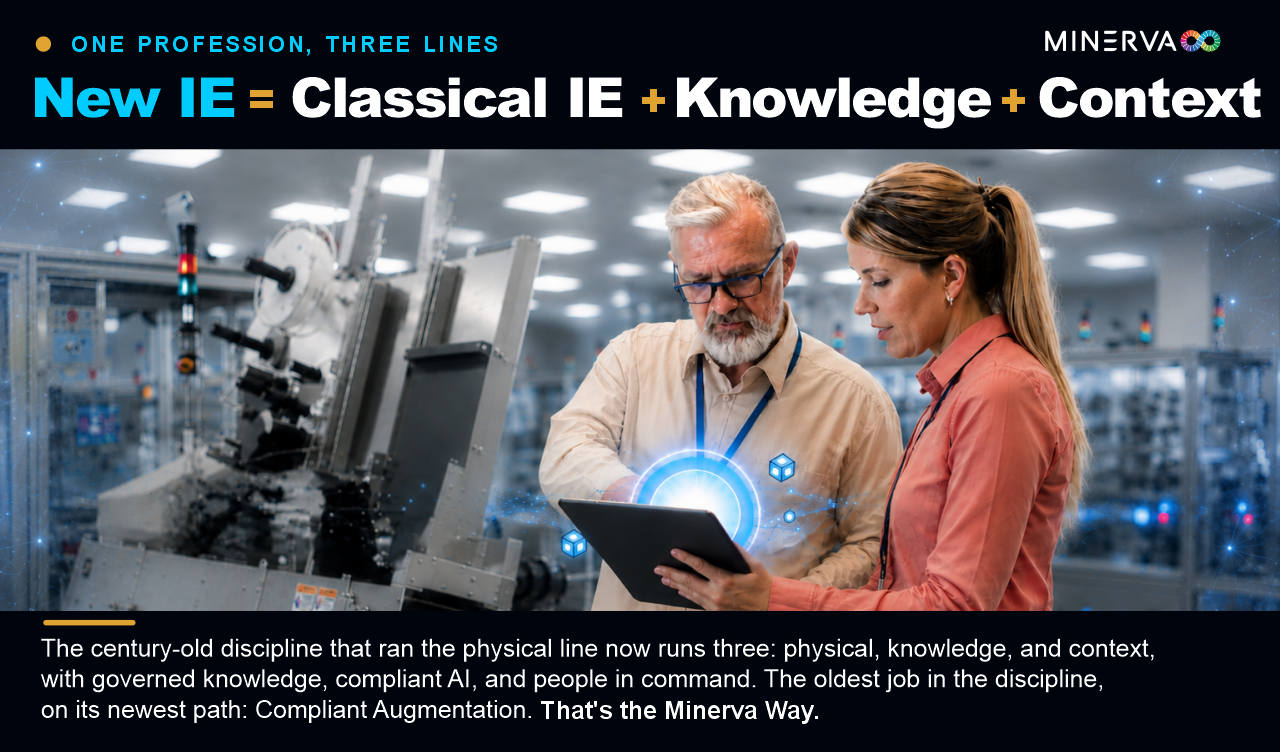
For over a century, the industrial engineer (IE) has designed the systems that produce things: integrated flows of people, materials, information, equipment, and energy. Where most engineers design products, the IE designs the process that makes them.
The IE’s work was always practical: see how it is done, capture the best method, standardize it so it can be repeated, and improve it so the next run is better than the last. The visible output was physical, but the captured method was knowledge, and capturing it, writing it down, and improving it was always part of the work.
For most of the past century, the IE worked within one arrangement of human and machine. The person was inside the system as the operator, doing or assisting the mechanical work by hand, and the knowledge moved by hand too, watched, written, reviewed, and carried one person at a time. It was essential work, and it was hard.
Then Industry 4.0 shifted that arrangement, and the IE shifted with it. The connected floor pushed for higher speed, higher productivity, and a smaller human component. In advanced economies, the machine took over most of the manual work. The IE now designed systems where the human moved from inside the loop to overseeing it, and trust became an engineering property, so a knowledgeable person could still challenge, stop, and answer for what the automated system did.
What the floor revealed is that an intelligent operation runs on governed knowledge. When the knowledge underneath is trusted, current, and connected to how the work is really done, the whole system performs. This is the IE’s own ground: the same lean instinct to smooth flow and remove waste now applies to knowledge itself, and the IE becomes the architect of intelligent systems, keeping machines, data, people, and decisions coherent.
For years, the intelligence on that floor stayed within set tasks. The floors the IE built ran on expert systems and machine learning, each a capable tool for a defined job. Then generative AI arrived, and because it appeared to reason and create, the instinct was to finish the job and replace the last human part, the thinking itself, by digitalizing knowledge and reasoning into a probabilistic model.
But that presumption did not hold. A probabilistic model can process and generate, and it may take on more of the responsibility over time, but it does not originate insight, create, or bear final accountability for a decision. Responsibility can shift toward the model; accountability stays with a human, the only being who can answer for a choice.
What is well recognized by the new IE is that the human is not a thinking machine to be replaced, but a creative, insightful, and accountable creature a generative model cannot stand in for. A well-integrated human in command of compliant AI augments the results of the process, so removing that human is never in the interest of the IE’s mission.
Industry 5.0 is the correction. The human returns, now recognized not as a mechanical part but as the center of command, with compliant AI augmenting rather than replacing, handing the IE a larger design space with a new objective: maximum augmentation, building the processes and systems that multiply what capable people produce.
That larger design space has a shape. The new IE is called to master three production lines, running at once and interwoven. The physical line still makes the product. The knowledge line transforms understanding into governed, verified knowledge at the speed of compliant AI. The context line arranges that knowledge as change parts, configuring the AI model for this process, this standard, this product. The material and the setup are one governed knowledge, doing two different jobs.
Data runs beneath it all, the substrate the knowledge rests on and part of what the context is built from, so keeping it sound is like keeping raw materials sound. Across the three lines the new IE owns flow, method, quality, and improvement, capturing understanding at the source, establishing the controls that keep it current and versioned, and making sure the work runs on governed knowledge instead of hand-kept paper sheets.
Life sciences is where this fits best. This sector built much of the foundation first. The accountability-first discipline its regulators have long asked for, every record governed, traceable, and answerable to a person, is exactly what the rest of the economy now needs for compliant augmentation.
Consider what a product development project produces: requirements, specifications, risk analyses, verification protocols, design history files. Every deliverable is knowledge, transformed stage by stage into governed, verified, traceable records. Product development transforms and produces knowledge, with inputs, quality controls, releases, and a finished product a patient will depend on. The ideal place for a new IE.
Through all of it, the new IE optimizes and augments by facilitating, from inside the value line, not above it. The line has absorbed the IE as a participant, not only as a designer and controller, so the IE now takes part in the knowledge work directly.
Together with scientists, development engineers, quality professionals, and operators, the new IE helps transform the knowledge, and stands accountable at the two gates: the gate where knowledge is verified before it is trusted, and the gate where what the work learns is folded back in.
The new IE keeps the whole system trusted, flowing, and calm, so that when the three lines, physical, knowledge, and context, move together with compliant AI and people in command, compliant augmentation follows. And it shows in output, people, and quality lifting at the same time.
So the new IE is an accumulation, not a reinvention. The century-old profession of integrated systems is now responsible for two more production lines, knowledge and context, and answerable to a better aim: the person in command, achieving more through the systems built around them, with industry, the patient, and humanity all benefiting from better solutions.
It is the oldest job in the discipline, on its newest path: Compliant Augmentation.
That’s the Minerva Way.