Quality and compliance work is generally counted as a cost. The hours spent on documentation, verification, and records land on the books as an expense, and the value they hold for later work goes unrecorded.
Leaders learn to see it in three kinds of spend: the work to prevent problems, the work to catch them, and the price of the ones that slip through. It reads as overhead, and their reasonable instinct is to hold it to the minimum the rules and customers allow.
But a surprise waits when a company governs its knowledge and brings compliant AI to the work. The same traceability, provenance, record keeping, revision, and approval that used to read as a cost to keep down are what make the knowledge trustworthy enough to keep and reuse at speed, turning it into a visible asset.
Governed knowledge and a human in command are what make AI compliant, and that is what transforms compliance cost into a productive asset that pays back in performance, quality, and customer satisfaction. The whole calculation turns over: from a cost to minimize into an asset to grow.
This was always true, but for a long time it was hard to see. When knowledge moved by hand, the payback came slowly, spread across years and later production, well outside the quarter a company measures in. Booking the work as a cost was reasonable, because within any reporting period that is what it looked like.
What changes now is speed. Put to work through compliant AI, governed knowledge pays back fast enough that the return lands inside the window where it can be seen, and what always behaved like an asset can finally be managed as one.
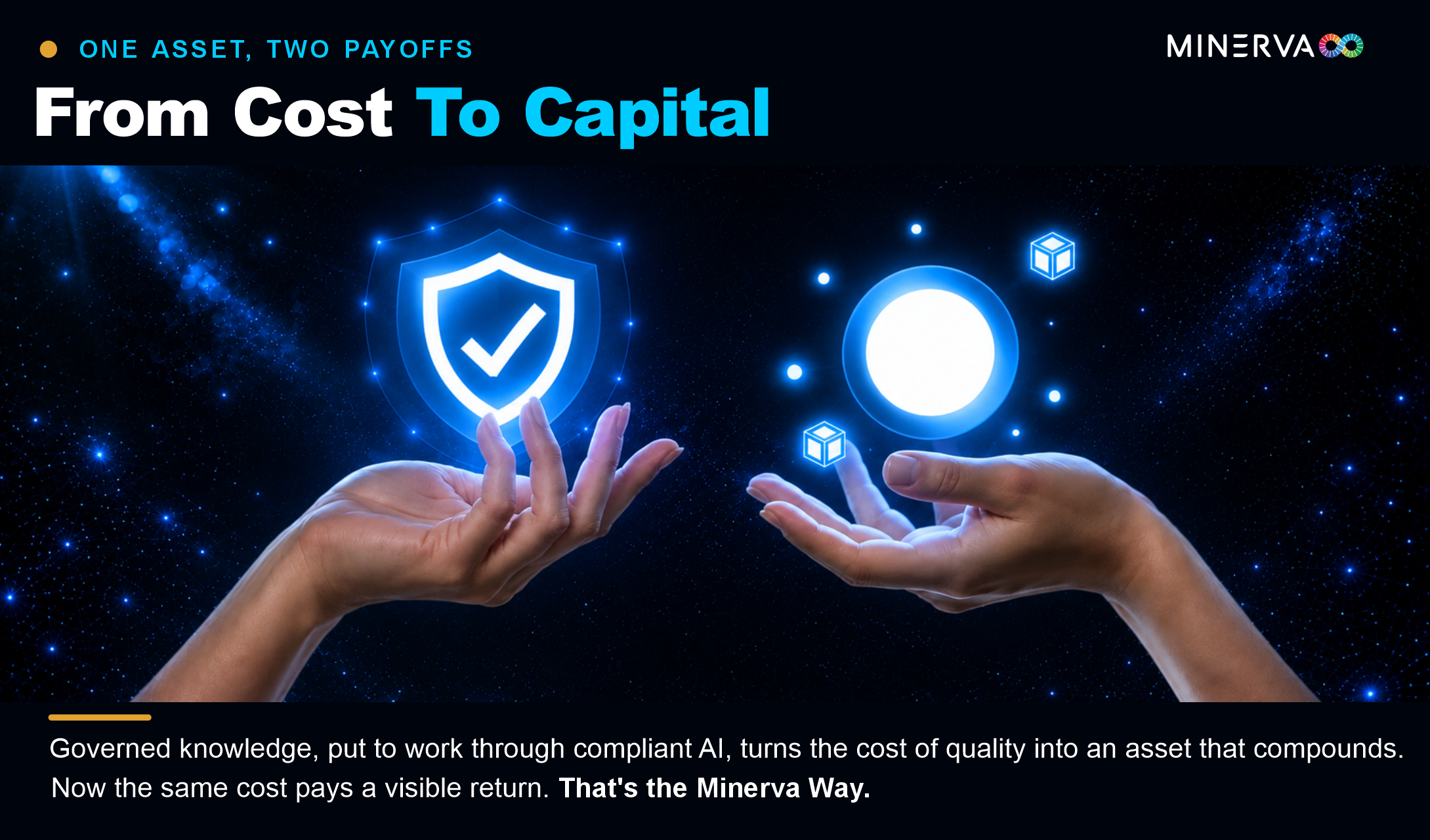
The records that satisfy the auditor are the same governed knowledge that fuels the work. One asset, two payoffs: proof for compliance, and fuel for augmentation, built once and used twice.
In regulated life sciences product development, the shape of it is clear. A team writes a design record, a risk assessment, a verification report. These are not overhead. They are core to the product, and regulation and good practice already call for them to be governed and used, not filed away once signed. That is exactly what governed knowledge is: each verified piece kept and put to use, so each product builds on the ones before it.
What compliant AI adds is speed and relief: working from the governed knowledge, it draws on that prior work in a fraction of the time and lifts the repetitive, exhausting effort off the people.
This changes an old tension. Productivity, quality, compliance, cost, and customer satisfaction usually pull against each other, so each is won by giving ground on another. When compliant AI runs on a trusted base, every pass of work becomes fast and light, and that trade-off loosens. A gain in one can now lift the others.
So the arithmetic runs the other way. The better a company governs its knowledge, the more it can produce, and the incentive flips: from minimizing the cost of quality to growing the asset that good compliance builds.
This gain is not automatic. The compounding continues only when the knowledge stays governed and a human stays in accountable command of the AI. The two hold the momentum together. Let the governance lapse and the context goes stale, the outputs lose their foundation, and the speed fades. Let the human step out of accountable command and the compliance case weakens, because the accountability that carried the work goes with it.
Discipline is what holds it in place, not a one-time transformation but a practice a company keeps through deliberate management. Sustain the governance, the human oversight, and the compliant use of AI, and the gains continue.
The reversal even reaches beyond regulated product development. In scientific research and research-use-only life sciences, where fewer rules compel the documentation, governing knowledge still turns effort into a reusable asset, and compliant AI still puts it to work. The payoff holds even where no regulator asks for it.
It also changes why the work gets done. The reasons were always there: do it well, satisfy the regulator, protect the patient. What is new is that the person doing the compliance work now has a new stake in what it makes possible next. Because the same governed knowledge that satisfies the regulator and protects the patient adds more fuel to their own augmentation. The old motive to do a good job now carries a new reward.
Compliance becomes the engine of the upside. The rigor it first demanded is exactly what makes augmentation possible, so the stronger the governance, the more it grows when it meets AI.
The auditor now has more allies. The audit still comes, as it should, and the multidisciplinary review that approves required regulated decisions stays exactly where it is. Now the audit confirms more than compliance: it confirms the conditions that make the company’s augmentation possible.
Seen from the top, this is an enterprise-value story. Governed knowledge behaves like capital that appreciates. Every project hands back reusable knowledge, and the firm that holds the most of it is valued more and ships compliant product faster.
In this industry, value tracks the product pipeline and the ability to execute, so speed lifts it in two ways: programs reach their milestones sooner, and the organization can carry a fuller pipeline. To a board, it is rigor turned into speed, and compliance spend turned into investment.
None of this happens on its own. The cost-to-asset reversal comes from people in command, accountable for decisions using AI, producing governed knowledge that pays back by freeing them to do more quality and creative work. The incremental end results are removed delays, reduced failures, and smoother paths to delivery, so patients receive therapies sooner and at lower cost.
So the cost of quality and compliance was never the whole story. Governed well, put to work through compliant AI, and kept under people in command, that spend becomes the fuel of compliant augmentation, and it pays a visible return. The cost-to-asset reversal belongs to the teams who see the organization’s knowledge as its greatest asset, and compliant work as an investment.
That’s the Minerva Way.