The intelligent organization has been described many ways. For some it is a company with a clear strategy and people aligned behind it. For others it is one that learns, adapts, shares what it knows, and decides on evidence. Lately the phrase has come to mean a company that uses AI across its work. Each of these descriptions captures something real, because each named the capability that mattered most in its moment and its industry.
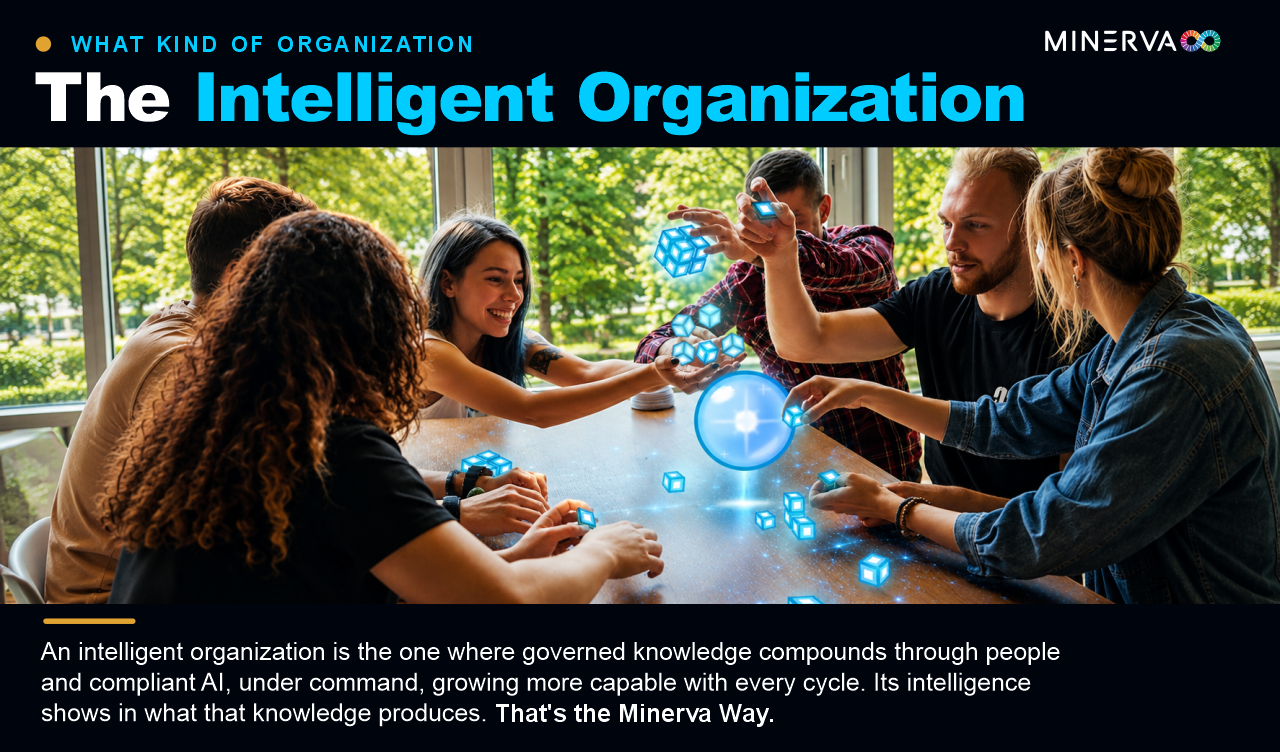
In the age of widespread generative AI, the term earns a sharper meaning. An intelligent organization is one where governed knowledge moves broadly, safely, and quickly through people, AI models, and systems, in a continuous cycle, the same shape in every industry. It does not only perform work. It produces trusted knowledge from the work, folds that knowledge back in, and starts the next cycle from a higher floor.
That is the doctrine of the intelligent organization: knowledge is the work, and trusted knowledge must be deliberately produced, governed, and compounded, with the human always in command. It rests on the same foundation everywhere, the interaction of people and AI models. Everything else, the system, the operating model, the choice of tools, follows from it.
This matters because executives usually begin with the result they want in mind: growth, revenue, innovation, impact. They want to know what kind of company can deliver those results faster than the references move, because those results only mean something measured against the references.
With generative AI, the reference points move faster every day. Intelligent competitors multiply by the month. Markets change shape before a plan is finished. Customers expect what they bought to be better the next time they use it. Capital moves toward innovation that delivers, and it moves without warning. All of it happens at once, and faster each cycle.
In this world, what matters is speed. Doing more with the given time. Being faster than the reference points. Generative AI has changed the speed calculation, because it has accelerated the making of knowledge itself. Knowledge can now be produced faster at every level, beginning with the smallest unit of intelligence in any organization: one person, in command, using AI.
Within that unit, the person brings purpose, context, judgment, and accountability. The AI model brings speed, references, synthesis, drafting, and generation. Together they can produce knowledge at a speed the person alone could not reach, but only if the person remains in command and the knowledge they work from can be trusted.
A team is a number of those units working together. A function is many of them aligned around one purpose. The organization connects them, governs the data they use and the knowledge they produce, and keeps them on a common goal.
In product development, this is easy to see, since much of the work is the creation of new knowledge around an original idea, need, or problem. Design inputs, specifications, risk analyses, studies, protocols, reports, and submissions are all knowledge products, trusted knowledge given shape.
The same is true everywhere else. Every customer interaction, investigation, service call, experiment, meeting, and decision produces knowledge. But in most organizations today, that knowledge scatters across messages, files, meeting minutes, memories, dashboards, and private judgment. It accumulates, but it does not compound.
That is the line management has to decide to cross: the change from ungoverned knowledge that accumulates to governed knowledge that compounds.
To compound, knowledge has to be trustworthy. It has to carry its source, reason, owner, version, and relation to the rest of the work. It has to be verified before it becomes a base for action, available to the people and AI systems that rely on it, current enough to matter, and stable enough to count on. Trust of this kind is architectural, not a feeling about the technology, but the result of the controls around it.
But governed knowledge is not enough. Since the human using AI creates new knowledge, the use of AI has to be compliant too. The knowledge has to be governed through verification, source assurance, and controls. The use of AI has to be compliant through governed context, evidence, written controls, and human accountability.
In life sciences the need is plain, because the work must stand up to inspection and patients depend on decisions made correctly. But the principle reaches any organization that wants its knowledge to compound, because a fundamental part of compliance is that accountability stays with the person. AI can recommend, draft, compare, and propose, but it does not own the consequence of a decision. A person does.
That changes how management sees people, because those using compliant AI are the engine that produces the intelligent organization. Management’s role is to facilitate that engine, by defining how knowledge is created, deciding where human command sits and what AI is allowed to do. This is the work of a management system for knowledge, peer to a quality management system, that governs the conditions under which trusted knowledge can be produced, used, and compounded.
From that system comes one of the hardest changes of all: how knowledge is controlled. In the old organization, knowledge conferred power and position when held closely. In the intelligent organization, knowledge held apart loses value and potential, because it cannot compound. This does not remove hierarchy, accountability, or decision rights, which still matter. But it changes where leadership power comes from, and what it ultimately creates.
Leaders no longer gain power by becoming the place where knowledge pools. They create value by making governed knowledge move, including their own knowledge. That requires a trade. Executives contribute their own knowledge to the common base and draw from the knowledge of all others on governed terms. In return, everybody gets an organization that learns faster as a whole than any single part can alone, and that returns more time to think and create the next iteration of the organization.
So the executive’s task becomes clear: create the conditions for knowledge to move without losing trust by investing in the knowledge line and in the people who make it run. It means helping them become stronger users of governed knowledge and compliant AI, sharper reviewers of what the model produces, and confident creators of what comes next. It means measuring what knowledge produces: faster development, informed decisions, fewer mistakes, better customer experience, and continuous product innovation.
When knowledge compounds, people create from incrementally higher floors, and the attention once spent searching, reconstructing, and rediscovering turns toward creating what is not yet known. The intelligent organization does not only produce more ideas, it moves a greater share of them through to innovation, because the same governance that makes knowledge trusted also makes creativity executable.
So the intelligent organization is not dependent on the AI model. Frontier models are available to everyone. It is intelligent because all its people create and compound governed knowledge with compliant AI, and the human in command. That is compliant augmentation: doing more with the time given, in compliance.
Speed follows from that. Better products and services follow from that. Growth follows from that. The organization is intelligent because its people are, and because management follows a doctrine that builds a governed web of people, knowledge, models, and machines, with the human in command, learning and innovating faster than its reference points move.
But one question remains, the one that gives the doctrine its direction: for whom. For the customer. That is the next part of the story.
That’s the Minerva Way.