In life sciences, a company is largely what it knows. The science, the molecule, the device, the process, understood, proven, and written down. Knowledge is the asset the whole business rests on. But knowledge does nothing on a shelf, a file, or a memory. It comes alive when a person puts it to work.
Underneath the work runs the universal knowledge cycle, the same in every industry: knowledge from the world, knowledge through the work, and knowledge back into a changed world.
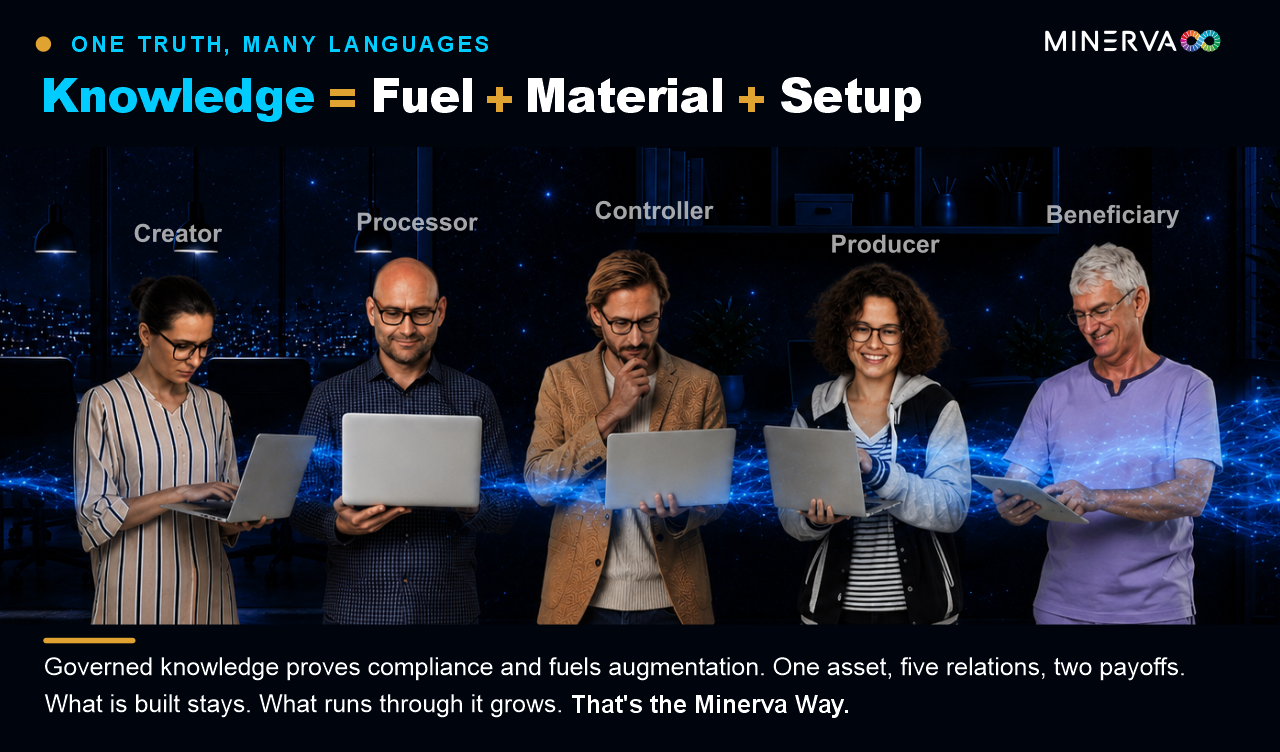
In life sciences, the knowledge cycle becomes a repeatable path, run the same way on every project, like a production line. A person walks it in five relations to knowledge: creator, processor, controller, producer, and beneficiary.
With AI, knowledge processing accelerates by orders of magnitude. So the path matters more, and one central job is to keep knowledge trusted. Trusted knowledge is what can be put to work at that speed and stay compliant.
Let’s walk the path.
The creator brings knowledge in by observing the real world: an experiment run, a process watched on the floor, a deviation faced head-on. A scientist, an engineer, or a market researcher sees what happens and understands it for the first time, turning data, information, and prior work, records, literature, and earlier papers, into knowledge the company can use.
Creator is the one relation a model cannot own. It can help organize and draft, but it cannot stand in the lab, see what happens, and understand it first, and it cannot carry the consequence or decide what the result means. That origination, and the accountability for it, stays with the person.
The processor gives the raw knowledge form by joining what the person knows with what the model works from, shaping it into a controlled document: a requirements list, a work instruction, a validation protocol. The model drafts from the verified source and flags what is thin. The person evaluates the draft and corrects it. What was raw becomes a processed result, ready for review.
To that work the model brings two things. One is the broad knowledge it learned from the wider world, vast but generic, unverified for any one job. The other is the context: the governed, versioned knowledge the company has verified and trusts, which configures it for the task at hand.
The model is the base motor, and the context is the setup that configures it, like the change parts that ready a line to make one exact product.
Now the line runs on knowledge as raw material and fuel.
With prior understanding at hand, less is worked out from scratch, so a person moves faster, the way high-grade fuel adds speed without knocking. Governed and trusted, the knowledge brings calm instead of second-guessing, the way verified material gives consistent results. Knowledge fuels the pace. Trusted knowledge feeds the calm.
The controller decides when processed knowledge can be trusted. Quality is built in, not inspected at the end, so produced knowledge passes a trust gate where it is verified before use, and released only when a qualified person signs.
At every step, the model recommends, the person commands, and the machine acts when a qualified, accountable person stands behind it.
Processor and controller create verified, versioned knowledge, the single source of truth, served to each reader in its own language. People read it as documents and dashboards. The model reads it as structured context. The machine reads it as control parameters, recipes, and settings.
One truth in many languages for many users. Because the source is single, governed, and versioned, all three, people, model, and machine, run on the same material and fuel. That lets them lift each other, because improving the source for one improves it for all.
The producer puts the trusted knowledge to work and produces the result, then watches how it performs and flags what stands out. At a learning gate, that learning is reviewed, and only what is approved becomes new governed context, ready to configure the next run.
In this path, productivity is best measured in verified knowledge. It takes two forms. The first is the verified output, counted in units from small to large: requirements and risk records, complete documents, and whole design packages.
The second is the learning that makes the next run better: a format improvement that accelerates revision, a structured table that helps build the architecture, terminology rules that better align the multidisciplinary team.
All of this verified knowledge and learning is built in one architecture, traceable down to its parts. So making documents comes to resemble assembling a medical device: small units, each cleared through verification, each carrying its record, traced and defended.
Because each verified unit is kept, the next project starts from improved material, the original plus what the work learned. Knowledge builds on knowledge, and each cycle begins from a higher floor. Unlike any ordinary fuel, this one does not just power the line. It grows with it.
Here is the edge. The governed knowledge built to satisfy compliance is the same that fuels augmentation. One asset, two payoffs. Which brings the cycle back to the beneficiary, and there is more than one.
One is the organization itself, an augmented whole of people, models, and machines. Its benefit is plain: the same submission-ready document set, built in a fraction of the time, through the same review standard, holding up under audit long after.
The people in it are beneficiaries too. What they gain takes the form of accomplishment, calm, and augmentation. Freed from repetitive, low-knowledge work, the people in command have room to do what only they can: create new knowledge and help bring life-saving therapies forward.
Most important of all beneficiaries are the patients and the doctors, who can receive devices and therapies sooner and at lower cost, as better work removes delays and lifts quality. What they experience feeds back too, monitored and folded in as learning, so the line that served them is ready to serve the next patient better.
And here is the quiet surprise. None of this added benefit was the goal. The goal was governed, trusted knowledge to meet regulation. The accomplishment, the calm, the room to create, and the better customer support arrive as a byproduct of getting the knowledge right.
So knowledge is the material, the fuel, and the change parts. The people collaborating with the model and the machine are the ones who create it, work it, govern it, grow it, and benefit from it. One truth, held in five relations and spoken in many languages, running a line that returns more than it takes.
That is the power of governing knowledge well. When combined with compliant AI it augments every person related to it.
That’s the Minerva Way.