Every company has heard the AI promise by now. Do more, spend less, move faster, and let the machines carry the load. It is a good promise, and it is worth wanting.
The harder part is making it last. The gains often arrive, impress for a while, and then level off before they add up to what was promised. Most good teams have felt this: a tool lands, a few weeks go well, and then the curve flattens. That is not a failure of effort or ambition. It comes down to one structural thing, and it is worth naming plainly.
We have seen the promise kept. The document work I have written about went from three and a half months to two weeks, at the same review standard, on the deadline. A client who had drawn a line against AI said yes once the team could show compliant use, with a human in command of what the model produced.
It held. The model was fast and imperfect, a person caught what it missed, and the work was completed as required. The design produced the result, not luck, so it could be done again. Output rose, and the people rose with it, from executors to reviewers to improvers.
The compounding showed even in those two weeks. Each correction a person made improved the next one, so the work moved faster as it went. What was learned on one document fed into the rest.
Here is why it held, and it starts with a distinction that matters. Validation, as the industry has always used it, is assurance of performance. It proves a system does what it should, at the moment it is checked.
Context Language Validation (CLV) adds a second assurance: trust and compounding. It proves the system can be trusted to act on what it knows, and that what it knows keeps getting better. Performance is a snapshot. Trust and compounding is the direction of travel.
Take the robotic system from earlier editions. Validation shows it runs as specified. CLV governs what it is allowed to know, so the team can trust what it sees, and so every case it learns makes the next judgment sharper. One assures the machine works. The other assures the knowledge grows.
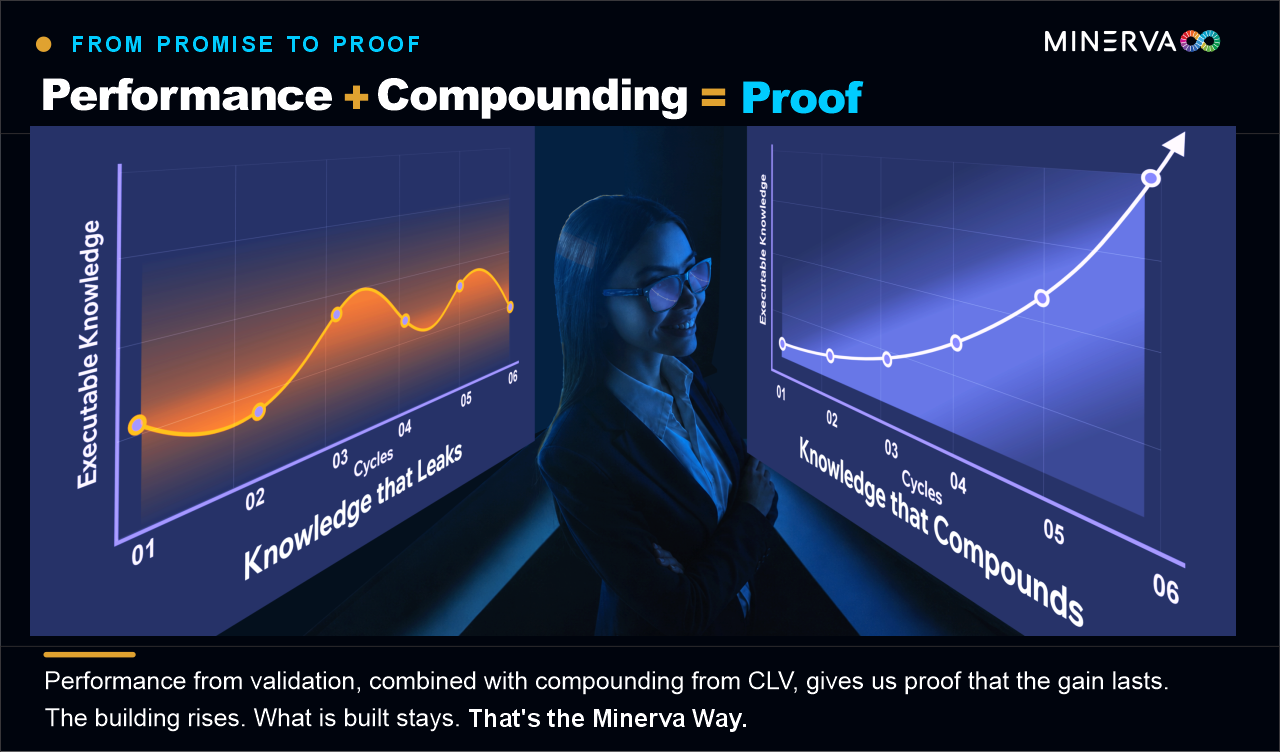
That growth is the engine. Under CLV, every verified case is kept, so the next one starts from more. Knowledge builds on knowledge, by design, for as long as the loop keeps running. The gain does not sit still. It compounds, run after run.
It is not one person’s learning that compounds, but the whole team’s. CLV gathers the verified knowledge of many into one governed context that the model and everyone can draw on. That is why the jump over working from individual memory alone is so large.
Compounding needs trust to work, because knowledge only builds on knowledge that can be relied on. The verification that makes each piece trustworthy is what lets the next piece stand on it.
None of that runs on its own. A person verifies knowledge before it is trusted, and a person decides what a flagged case should teach the system. The compounding is real because people drive it, and that is also what keeps it honest.
There is something rare here. The system gets better as a byproduct of being used correctly. Under CLV, improvement is the residue of the work itself, not a separate initiative.
And it does not lean on any one model. CLV governs the context the model reasons over, not the model’s inner workings. So when a stronger model arrives, and one always does, the governed knowledge and the gates carry straight over. The engine keeps running while the parts beneath it change.
The contrast is what happens without that control. Ungoverned context does not compound. Each result mostly stands alone, little verified carries forward in a form the next run can trust, so gains still come but cost close to the full effort every time. That is the wall the promise so often meets. Not a wall of weak models or weak teams, but a wall of uncontrolled context. The work still moves things forward, only slowly and unevenly, because effort repeats instead of accumulating.
So the difference between a gain that lasts and one that fades is not who worked harder. It is whether the knowledge underneath can compound. Compliant Augmentation is built to compound, which is why the promise, in this form, finally holds.
This is also why the three gains from the last edition keep rising instead of topping out. Output, knowledge, and people all grow because the knowledge they draw on grows. Each run leaves the next one better placed.
In manufacturing, all of this takes a clear shape. More good batches, a process that sharpens with every run, and a record that holds up long after the work is done. That is success that keeps building, not an initial strong stretch that fades.
And downstream, more good batches mean more therapies reaching more patients, faster and at lower cost. The patient is the reason at the end of the line, reached through better manufacturing.
The promise was always worth wanting. What was missing was proof that the gain would last. The proof is in the compounding: governed knowledge builds on itself and keeps going, while uncontrolled context hits the wall. CLV turns a passing gain into one that holds and grows, and a hoped-for promise into one to build on.
That is the shift this series has been making all along, from promise to proof.
That’s the Minerva Way.