Twelve instrument assembly work instructions. Some made up of up to two hundred knowledge packets.
A knowledge packet is one self-sufficient instruction: the command to carry out, the parts and their numbers, the tools, the verifications it requires, and a fully complementary pictorial — a balanced unit of visual language consisting of image and text, an isometric view with reference photo, callouts, the arrows that show movement and direction, the warnings. One knowledge packet, one page, one act of work made unmistakable to a human and a machine at once. Twelve documents with about seven hundred and twenty of them.
In the old way of working, twelve of these took us three and a half months. The same team made the next twelve in two weeks. Same volume. Same quality. CADs included. Ten working days, two of them weekends — for an R&D device manufacturer who needed twenty-four assembly work instructions for a flagship product, twelve already made and twelve still to go, with the deadline closing.
It’s real. These are numbers, not a story.
But speed was not the first thing that changed. Permission was.
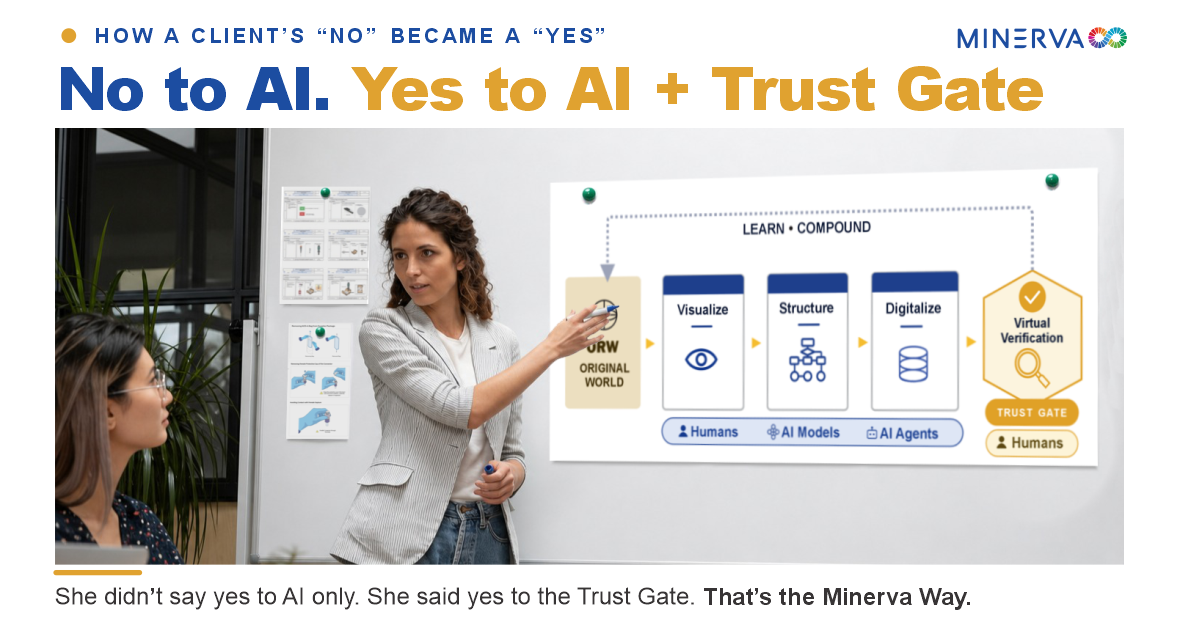
The client had drawn a line: no AI on her documents. A reasonable line — it is her quality system and her ISO audits that these must satisfy, and it is her name on them, not ours. So, we told her the truth. The deadline was reachable, but only one way: let us use AI under a model where a human reviews everything it produces, every component of the packet and their integration, before any of it is trusted. Not AI instead of people, AI underneath them. She did not say yes to AI. She said yes to the application of the Trust Gate — compliant use, human in the loop, no exceptions.
And then the two weeks happened, and what she actually agreed to made the whole difference.
The failure nobody’s framework catches
Giving her due credit, her caution was right, and here is the proof of why. Every AI-governance framework on the table misses the same thing. Georgi Tancev, in his paper Governing Large Language Models in Regulated Pharmaceutical Environments: A Risk Engineering Framework, named it plainly: delegation corruption. Hand a model a long, multi-step job and let it carry the work on its own, and the errors do not announce themselves — they accumulate, quietly.
In one independent study — dozens of AI models, long multi-step editing tasks — roughly a quarter of the documents came out corrupted by the end. Not our work; a controlled benchmark. And the result that undoes the obvious fix: asking the same model to check its own output did not catch the errors.
So “human in the loop” was never a slogan for us. It was the only honest answer to a real defect. In our own work, across these hundreds of instructions, the number the teammates running it saw was about one in five — roughly twenty percent of what the AI proposed, they sent back. The other eighty percent, or close enough, was sound.
Eighty percent.
The design choice
Here is where most of the industry goes one way and our client went the other. The instinct, when AI is eighty percent right, is to wait — for the better model, the next version, the one that finally reaches a hundred. The one that does not hallucinate. She didn’t wait, because we built the entire process around the eighty.
The AI assembled the parts of the packets and its integrated result. A human reviewed, rejected what was wrong, corrected it, moved on. That human-in-the-loop is what turned eighty into a hundred — and it is exactly the model we had promised the client. The twenty percent the AI missed was not a defect in the plan. It was the plan. We designed for an extremely fast, imperfect machine on purpose, because an imperfect machine you have engineered around ships the work, and a perfect machine you are still waiting for does not.
People on the team started calling the fortnight a “summer miracle.” It wasn’t a miracle. A miracle is something you cannot repeat. This we can repeat — because the design, not the luck, is what produced it.
What the handoff actually bought
The quiet part, and the part I care about most: handing the repetition to the machine did not reduce the team. It raised them.
When the AI absorbed the hundreds of repetitive activities necessary to assemble every packet, it gave back the one thing the deadline had taken — time to think and create. In the space of two weeks the team moved from executors to reviewers, and from reviewers to something better: improvers. Review stopped being about checking and started being about making it better — and every improvement fed back into the next packet, the next document. The repetition went to the machine. The judgment, the creativity, the improving — that went up, to the humans, where it belongs. All of this inside a well-understood and governed risk boundary.
That is the whole thesis, lived in numbers. Augment. Don’t replace. We have said it for years. This is the first time we can show the receipt.
What comes next
Let me mark the line clearly, because a log that claims more than it has lived stops being honest.
What we proved is the gate where the document is made. Twelve documents, built around an imperfect machine, under human review, finished at client quality, on the deadline. That is the answer to delegation corruption at the point of creation.
The gate where the document is used by the client — where a procedure drifts as edits are made and the world around it changes, months after anyone signed it — we have not run yet. That is the one we are looking forward to. It begins now, on the revision of these same documents. We’ll write about it when it is finished. Not from inside it.
The rule
Stop waiting for the AI to be perfect. It won’t be, and the work is due anyway.
Put a human on the twenty percent the machine gets wrong — inside the work, not after it — and design the whole process around the machine you actually have, not the one you have been promised. That is the model that turned a client’s no into a yes. Eighty percent is where the AI stops. That is where we begin.
That’s the Minerva Way.
— Rogelio