For several editions now I have followed the same running example: an AI-enabled robotic cell-culture system that incubates cells for advanced therapies, watches the culture as the process runs, and recommends the machine’s next move. The goal has not changed: fewer failed cultures, more therapies reaching patients, and lower cost.
The last edition ended on a strange principle. The most valuable thing the AI model can produce is not an answer. It is the moment it says it does not have one. This edition is about what happens next.
In a system built to learn under control, a flagged case sits right at the edge of what the model knows. That is the most useful place it could be, making the moment of doubt the start of the next improvement. The question is how to capture that without loosening the controls that keep the system trustworthy.
Context Language Validation (CLV) answers that in five stages: Define, Lock, Apply, Monitor, and Review. The context is the knowledge the system is allowed to judge against. Review is where the framework stops looking like the computerized system validation (CSV) the field already knows.
In traditional CSV, review is often periodic and change-driven. A system is validated, placed under control, and maintained in its validated state until a change, incident, or review requires action. In CSV, review exists to protect the system from drifting away from what was validated.
On the other hand, the CLV Review stage protects something different: a system whose approved context can improve version by version. The flagged cases are not noise to clear away. They are raw material, turned under human control into the next version of the context.
Here is how that turn happens. In the Apply stage, a person authorizes the machine’s action at run time: approve, override, or hold. That is the run-time authorization, the human in command of the action. For example, the system sees clumping start to form and recommends a de-clumping step. The person in charge looks at the live culture, checks it against the references, and approves the run.
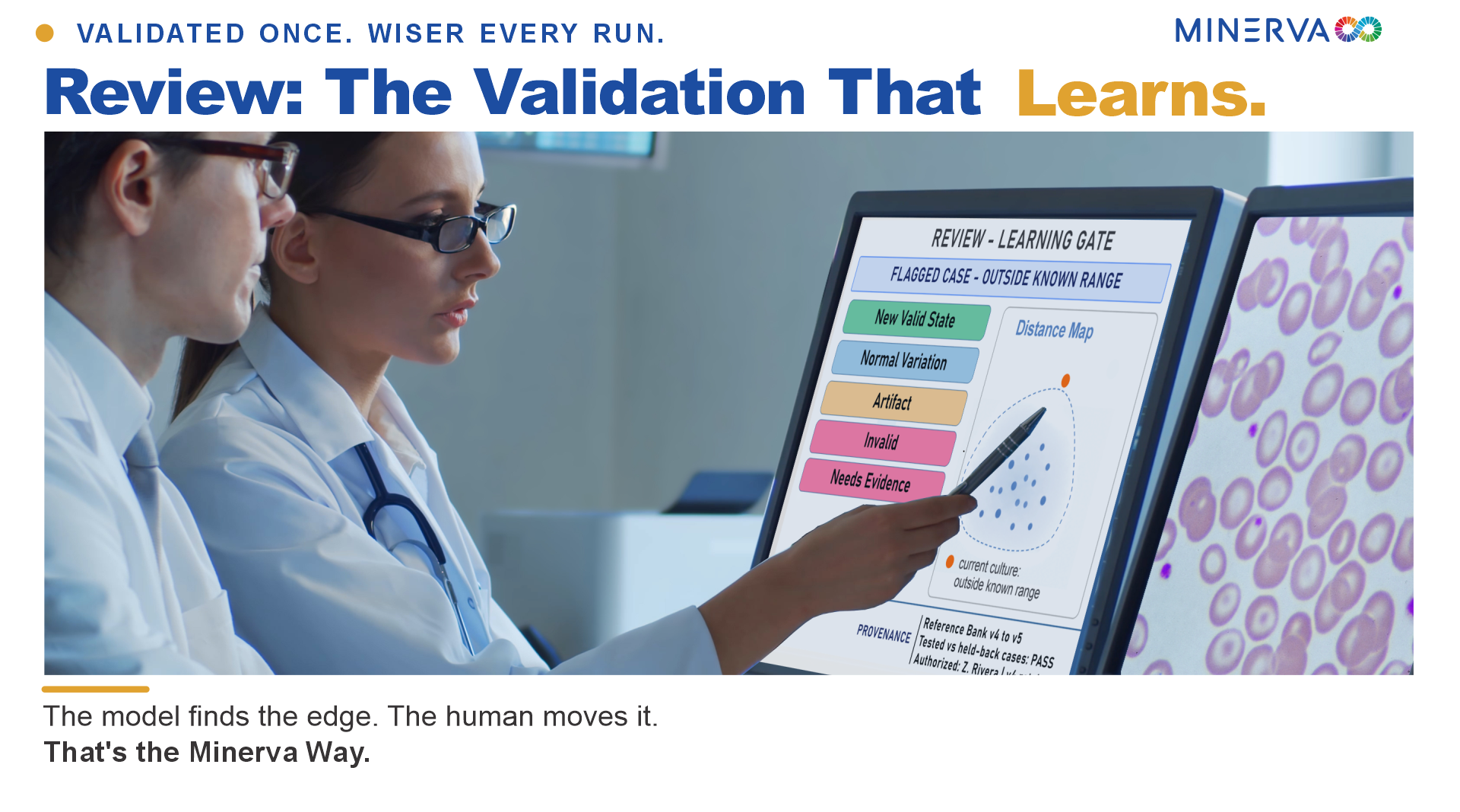
When a case is flagged during the Monitor stage, it is examined, and a person decides what it is: unknown, normal variation, an artifact, an invalid data point, or a case that needs more evidence. Or it may be something more valuable: a new valid state the system needs to recognize next time.
The point where a human decides whether a flagged case is something the system should learn from is the Learning Gate, which lives within the Review stage. It is the same human posture as the run-time authorization, yes, no, or not yet, but no longer a live call during the run. It comes later, once the flagged case can be examined in full.
The mechanics are concrete. A reviewer looks at the flagged culture with everything gathered during the Monitor stage: the image, the trend, the confidence, the distance from the reference bank.
If the case turns out to be a new valid state, it is proposed as a candidate for the approved reference bank. Since changing the reference changes what the model knows, it is tested against held-back cases, edge cases, known failure patterns, and predefined acceptance criteria. If the evidence supports it, the change is verified, approved through the proper control, and locked as a new version. That verification guards any knowledge before the system is allowed to trust it.
Each change carries its provenance. That is the discipline that makes the learning defensible. Every approved improvement is a new, superseding version of the context, with a record of what changed, who authorized it, how it was tested, and why it was approved. The old version does not disappear. It is kept, so an inspector or auditor can always see what the system knew at any point in time.
The more the system is used, the smarter it gets, and the record only grows. In the old approach, drift can happen quietly until the validated state is compromised. Here, each approved improvement is captured, so the same drift that once meant decay is steered, run after run, into more capability.
Notice the result: human experience and knowledge are improving the system, deliberately, under control. The model does not retrain itself or quietly move its own line. It surfaces the cases it cannot decide, and needs a human to resolve them. Any change is assessed, tested, approved, and locked by a human. The learning is real, and governed at every step by a human in command.
That climb has a name. Engineers call it the march of the nines: reliability rising from ninety percent, to ninety-nine, to ninety-nine point nine, each gain earned, tested, and proven rather than claimed. Escalations grow rarer, and when the gains are tied to cell-culture outcomes, every nine should mean fewer failed cultures, which is the whole point: more therapies reaching patients, faster and at lower cost.
And that closes the loop. The flagged case became a question. The question became reviewed evidence, and that became verified knowledge. The verified knowledge became the next version of the context, which is part of how the system is defined. Review hands back to the beginning, and the process starts again, one cycle wiser than before.
Here is the inversion the series has been building toward. In a frozen system, being validated means staying the same, and the human’s job is to hold it there. In a living one, it means something better. It means the system is allowed to change, and the human is the one who improves it, able to show that each approved change preserved or improved trust against criteria set in advance.
That is the validation that learns. A system worth trusting is not one that never meets something new. It is one that meets something new, says so, and is a little wiser the next time. The model finds the edge. The human moves it.
That’s the Minerva Way.