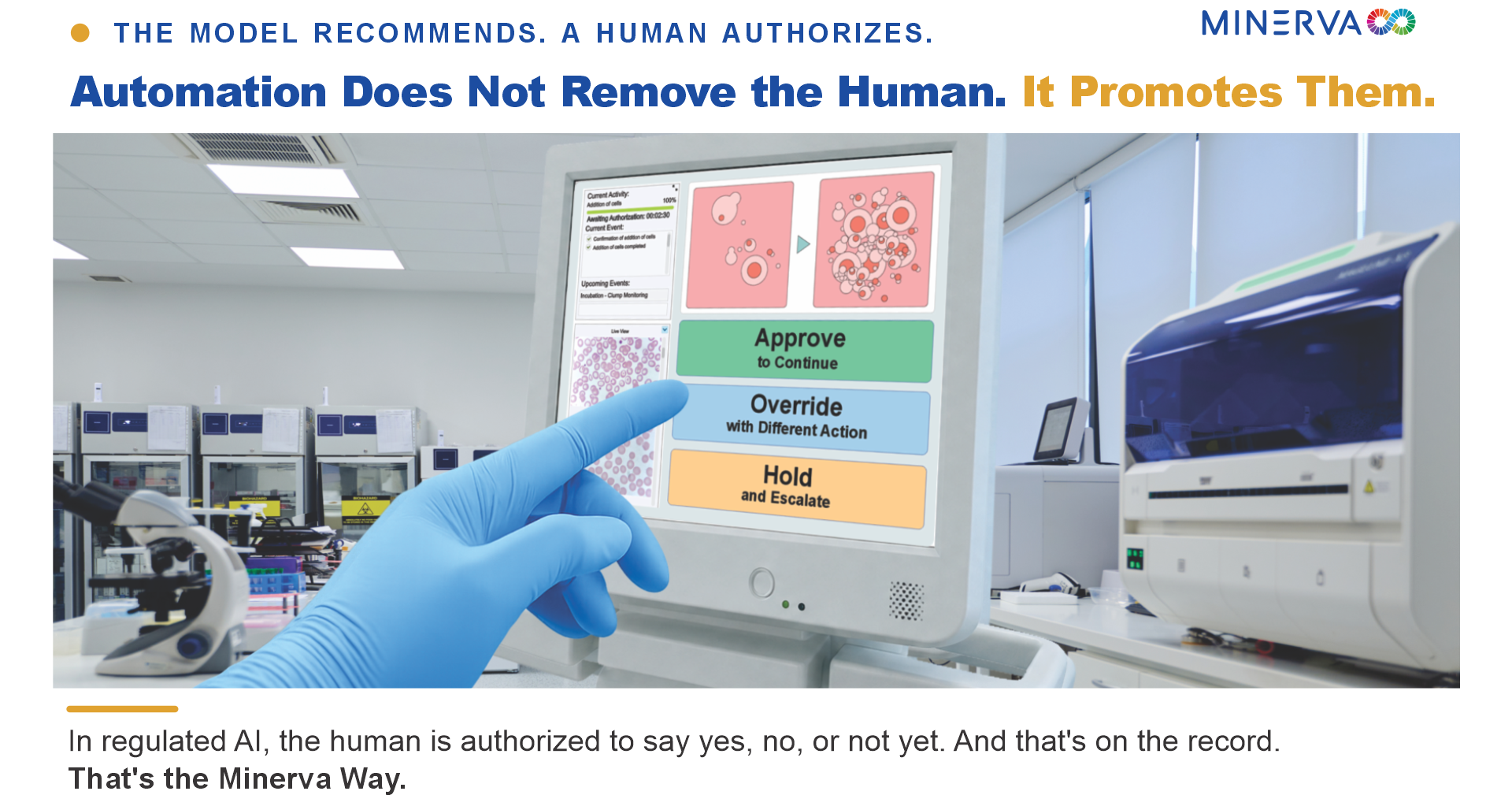
Picture the same system from the last two editions, the one that incubates cells for advanced therapies. It watches the culture, sees a problem forming, and recommends the machine’s next move. The goal: catch problems early, fewer failed cultures, more therapies for patients, and lower cost.
The system watches continuously, and it could act on its own. But at the decisions that matter, it does not. It stops and tells an assigned person: this is what I see, this is what I recommend, do you approve? The person can approve, override it with a different action, or hold and escalate. And only then does the machine move.
That pause is easy to miss, and easy to wave off as a safety nicety. But it is neither. It is one of the most important parts of the system, a control in its own right.
This edition is about what happens after the model speaks: it has made its recommendation, and now someone has to decide whether the process should proceed.
Start with how the work used to be done. In many manual processes, one trained operator stood at the workstation, watched the process, judged what was seen, and acted on it. Observing, judging, and acting were one job, usually one person, under an approved procedure.
Now automate that step. The system can watch, and it can act. But the judgment does not vanish, and neither does the responsibility. They just split. The model recommends, and the human authorizes. What was once one motion becomes two: the recommendation to act, and the authorization to proceed.
So what does the AI buy you, if a person still has to say yes? It can sense and measure what a person cannot, at a scale no person can match. It watches every image, continuously, and measures how much the cells have clumped, how evenly they are spread, and how the culture compares with thousands of approved cases seen before. And it holds many signals at once, the image together with pH, dissolved oxygen, temperature, and volume, and tracks how they move together, live.
That live view changes what is possible. A person reading reports is looking backward, at where the process was when the data was pulled. The system watches the trajectory as it forms, and can flag an adverse trend before it becomes a deviation, while there is still time to save the batch.
So the model does not replace human judgment. It gives that judgment far more to work with. But here is what matters: the model does not produce trusted knowledge on its own. It produces observations, measurements, classifications, and recommendations. Those become trusted, executable knowledge only after a human verifies and accepts them. This is the kind of many-signal pattern detection AI can be good at, when it is trained, bounded, validated, and monitored properly. The human still decides, but now with more evidence, and early enough to matter.
In the manual world, authorization was never a separate step, because observing, judging, and acting were one motion, done by one person. But once you separate the deciding from the doing, authorization becomes its own control. Someone has to be named to give it, the system has to wait for it, and it has to be recorded.
That authorization has three answers: approve the recommendation, override it and choose something else, or hold and escalate. A gate that can only say yes is not a gate. If the only allowed answer is approval, you have not kept a human in the loop. You have given them a rubber stamp.
And because this is a regulated system, that decision is part of the record. The record captures what the person was shown, what the model recommended, what they chose, and why they overrode or escalated. The audit trail captures who acted, when, and what changed. Together they let you reconstruct not just what the machine did, but who authorized it, and on what basis.
This is also where the authorization gate earns its place. A model can be confident about something it has never seen. It might read a new pattern as normal and recommend continuing, when the right move was to stop and ask. The gate can catch that, but only if the person is shown enough to challenge the recommendation: the image, the trend, the confidence, the uncertainty, the comparison cases, and the reason behind it.
And evidence alone is not enough. The person has to be trained, qualified, given enough time, and given real authority to disagree. The workflow must not make approval easier than rejection or escalation. The person is not there to second-guess every easy call. The person is there for the call the model may not know it is getting wrong.
So does this mean a person has to approve every move forever? No. Oversight can sit at different levels. Some steps need authorization before the system acts. Some need a human to verify the output after. And mature, lower-risk steps can run under monitoring, with a person stepping in by exception.
But a step does not drop to a lighter level by default. It has to earn it, on evidence: predefined acceptance criteria, performance within agreed limits, understood failure modes, validated detection and fallback, approved change control, and continued monitoring. And you have to show that a wrong call is caught before it can compromise product quality, patient safety, data integrity, or timely delivery.
As that evidence builds, a step can move from approval each time to monitoring and intervention by exception. But it does not quietly slip out of human control. It graduates, on the record, when it has shown that it can.
So the model sees what no person could watch continuously, and when authorized, the machine carries out the action. But the authorization belongs to a person, and that decision is on the record.
Automation did not take the human out of the work. It took over the part people do poorly, the continuous, quantified watching, and moved the human to the part only a person can own: accountability for letting the process proceed.
That is the promotion. The better the model gets at seeing, the more the human’s role concentrates on judgment, authority, and accountability.
CSV locks the machine. CLV governs what it is told. But neither one decides whether and how to act. A person does, and that decision is on the record.
A human in the loop is not a human watching. It is a human authorized to say yes, no, or not yet.
That’s the Minerva Way.