The Edition
A patient depends on a therapy. Not now and then, but on a schedule, at a set frequency, to keep the treatment working the way it should. But for a long time, the therapy was hard to count on. Some weeks it arrived on time. Other weeks it was late, or not ready, and the schedule slipped by days. Sometimes weeks.
When that schedule slips, the whole plan of care suffers. And the strain does not stop with the patient. The nurse cannot administer what has not arrived. The doctor watches the plan slip. The caregiver who arranges the whole day around the visit arrives to find there is nothing to give. Appointments get rebuilt, and everyone around the patient carries a little more worry. On top of it, the price kept climbing.
Underneath all of it was a quiet erosion of trust. The patient depended on the therapy, and on the company that made it, but could not count on it being there. And the patient was not alone. The doctor who prescribes it, the nurse who administers it, the family whose peace of mind rides on it, all of them are customers too. The patient is the ultimate customer, but far from the only one. And none of them was satisfied.
Then something changed. The therapy started arriving on time, every time. The treatment followed its plan without the gaps, and the patient began to feel better, not because the medicine was different, but because the treatment was finally going as designed. The nurse could deliver on schedule. The caregiver’s trips were no longer wasted. The doctor’s plan held. The circle around the patient could breathe.
Later, the price began to come down. The patient could afford to keep a reserve, and the hospital could stock more and hold it ready. Each person in the circle experienced the change in their own way. The patient felt it. The doctors noticed it. The caregivers and the family enjoyed it. None of them knew what had caused it.
What the customers did not know is that the company behind the therapy had walked a path. First it became an intelligent organization, looking inward to build a shared language its people and its compliant AI could read the same way. Every decision rested on verifiable context. Then it governed and compounded its own knowledge until the mistakes fell away and its production and deliveries became dependable. That is what put the therapy there on time, and returned the trust.
Then it took the second step and became customer-centric, and that is what brought the price down. Not as a giveaway. Reliable production brought higher volumes, so a lower price put the therapy within reach of more people. And when the market grows by more than the price gives up, the company earns more, not less. A win-win, made possible by becoming a customer-centric intelligent organization.
The order matters, for two reasons. Customer knowledge is sensitive, carrying privacy, confidentiality, trade secrets, and market strategy, so it can only be brought inside safely once the governance is mature. And customer-centricity is an act of empathy, which takes time and attention, the very time an intelligent organization returns to its people once they are no longer putting out fires.
A customer-centric intelligent organization brings the customer into the intelligence line as protected, role-appropriate knowledge, transformed from complaints, surveys, tickets, and market research into something the organization can safely use. It comes in carefully, through a structure that decides what is captured, how it is protected and verified, and who can use it. The least sensitive comes in first. It reaches each person with what they are entitled to see, to improve their work and create in the time given.
That is how the customers’ conditions, results, and experiences become new language. It is added to the corpus the company built to become intelligent, until the customers’ language and the company’s language are one. No translator is needed, and the data stays confidential. Only what is relevant and allowed at each position is called up from the knowledge everyone acts from.
The language never stops growing. It stays current and carries the risk, the trajectory, the provenance, and the benefit of every piece across the whole chain. Customer-centricity becomes a constant state, not an event. And the company keeps creating for the customer the next improvement, the next product, the next reason for the customer to stay, and for them to tell others. Thinking with the customer and growing the market become the same act.
A customer-centric intelligent organization challenges an old paradigm. The belief that no company can fully satisfy every customer, that total satisfaction is impossible, that a difficult few will always stay out of reach. It was a fair belief under the old way of managing knowledge, because knowledge did not compound. Each hard problem was met without the advantage of everything already learned. So satisfying that last, hardest group demanded effort that often was not available, or not possible at all.
But that was the past. When knowledge compounds, the company does not start over each time. It builds on everything it has already learned. Reaching the last customer still takes creativity and effort, yet it is no harder than the step before. The march of nines runs all the way, ninety percent, ninety-nine, ninety-nine point nine, until total satisfaction is no longer a fantasy. For a company that compounds its knowledge, that is where it inevitably arrives.
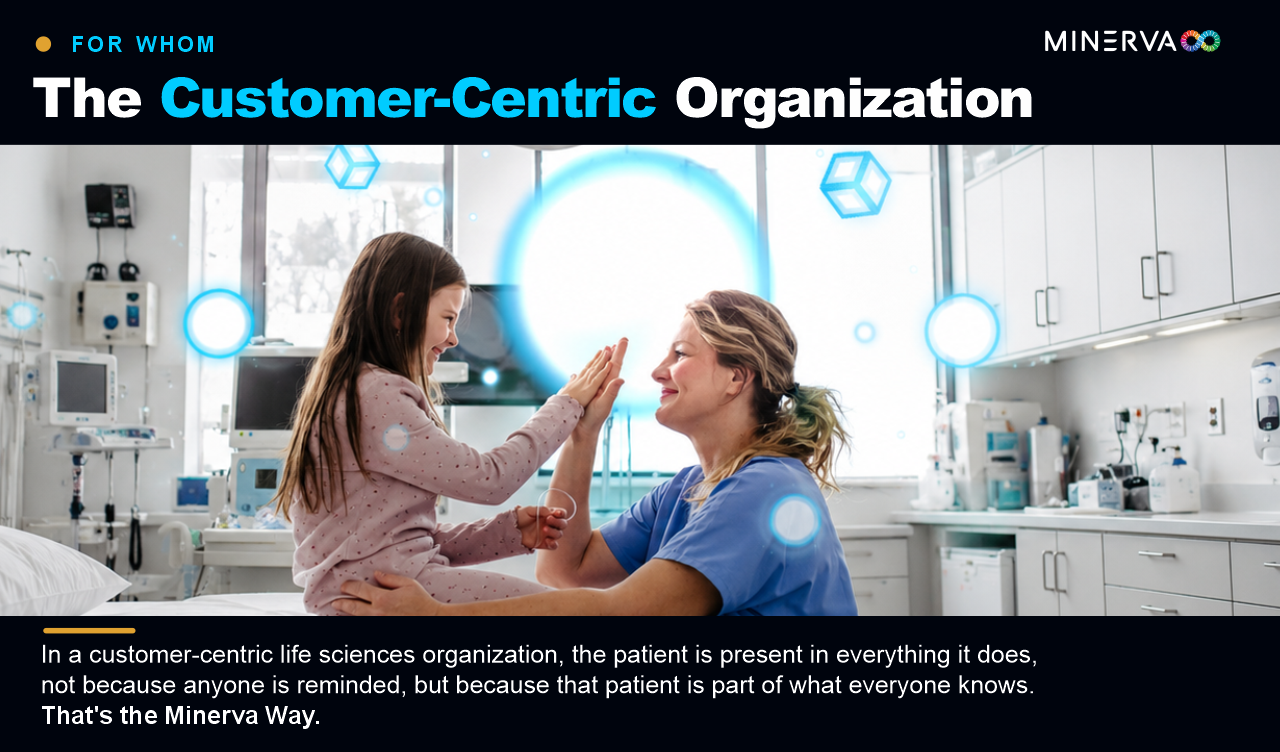
And the patient we began with is present now in everything the company does, not because anyone is reminded, but because that patient is part of what everyone knows. In regulated life sciences, the patient is the ultimate customer, who gives compliant augmentation its purpose. Governed knowledge, compliant AI, and the human in command create together for that ultimate customer, the patient who started it all.
That’s the Minerva Way.