For this series I have followed one running example: an AI-enabled robotic cell-culture system that grows cells for advanced therapies. It watches the culture as the process runs, and recommends the machine’s next move. The goal has stayed the same. Fewer failed cultures, more therapies reaching patients, and lower cost.
Before that system can watch a culture and recommend a move, it has to be allowed to know some things. Important among them is how to keep the cells well dispersed, because in this process cell dispersion improves performance. When the cells are spread out, each one can meet the nutrients, vectors, and enhancers that turn it into a transformed, therapeutic cell, and let the culture grow to the numbers a therapy needs. When they clump, that contact is limited and performance drops.
So a smart system has to know what good cell dispersion looks like, what clumping looks like, and how much clumping is too much to leave alone. That starting knowledge is part of the context the system uses to make decisions: the map that tells a healthy culture from one in trouble, or a dispersed culture from one starting to clump. Before the first run, this context has to be built by humans, who turn raw information into knowledge the system can trust.
That process takes place at the initial stage of the Context Language Validation (CLV) lifecycle. CLV is a close counterpart of computerized system validation (CSV), a discipline of the regulated industry that proves a computerized system does what it should. The CSV lifecycle starts with the system definition, set down in a user requirements specification, or URS, that forms the base for building the system.
CLV runs in the same spirit. It starts with the Define stage, where the knowledge to be fed into the system is established. That knowledge includes what the system is allowed to see, how it is allowed to read it, where the limits are, and what response is required when those limits are crossed.
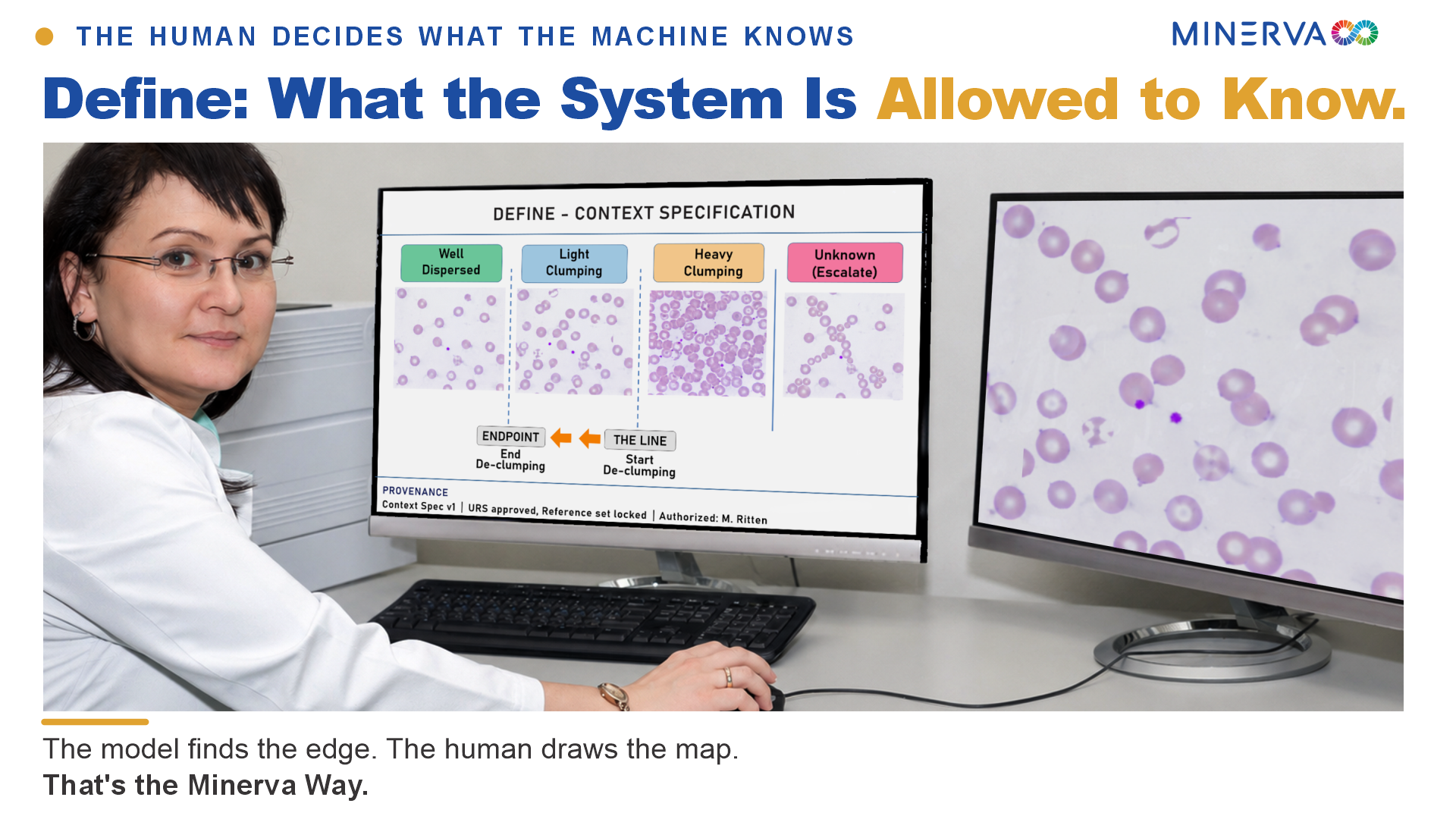
The best way to understand the Define stage is to start from the basic system requirement: the system should optimize cell transformation and numeric expansion. That requires keeping the cells apart, and stepping in when they start to clump. That leaves the system with three decisions. The first is whether to act at all in the presence of clumps. Some clumping is minor. Some crosses a line and needs to be dispersed. A person decides where that line sits. Below it, the system leaves the culture alone. Above it, the culture may need a de-clumping step. That is the first call, and a person makes it ahead of time, by setting the line.
De-clump, or not. And if de-clumping, how hard.
The second decision is how hard to act. Too little intensity and the clumps hold. Too much and the force hurts the cells. A person decides which level of intensity fits the amount of clumping. Enough to break the clumps, gentle enough to spare the cells.
The third decision is when to stop. A de-clumping step does not always clear the clumps in one pass. So after each pass, the system checks the culture against the reference again. If clumps remain, the step repeats. If the culture is dispersed enough, the work is finished. A person sets that endpoint too: how dispersed counts as finished, and how many passes is too many.
And behind all three sits risk. Waiting too long lets the culture fail. Acting too aggressively costs cells. Stopping too soon lets the clumps return. And some cultures will not fit the map at all, which means the case should be escalated, not acted on.
All three decisions rest on things a person put in place beforehand. First, the pictures. A qualified person selects and approves a set of images that show what light clumping looks like, what heavy clumping looks like, and what a well-dispersed culture looks like. The images earn their place because a human chose them to mark the stages. That is why the reference set is decided, not discovered.
Second, the measure. Clumping must become a number, or it stays a matter of opinion. A person picks what to measure, like the size of the clumps, how many there are, and how far the culture has drifted from a well-dispersed one. Progress is read in those terms, against the reference images.
Third, the line, the levels, and the endpoint. A person sets the line where clumping calls for action, which intensity level the procedure should use at each point, and the endpoint that marks the work as finished. The machine measures, recommends, and acts. But the line, the levels, and the endpoint were set by a person, before the run.
Define is set by humans, who decide what counts, what matters, and what to do about it, before the system is allowed to act on its own. Define writes those decisions into the context specification. Then a qualified person checks it all and locks it as a trusted version. Nothing runs against a reference that was not checked first.
There is a reason I addressed Define last in this series, even though nothing works without it. Everything in the other stages depends on what a person sets here, at the start. Lock, Apply, Monitor, and Review all act on the context that Define brought into being. So the model works only inside the map a person approved, and it can only know what a person decided it would know. The quality of the whole lifecycle begins at this first stage. By a person. On the record.
And that closes the circle. What Review approves becomes part of what Define writes next, so the loop turns again, on better material.
This is human work, start to finish: setting the line, approving the pictures, choosing the intensity, setting the endpoint, defining the escalation. It is human judgment about what matters. And that judgment is the foundation. What gets built on it is where this series goes next.
The model finds the edge. The human draws the map.
That’s the Minerva Way.