Last spring I watched a small team solve in an afternoon a problem that used to take days to address. They used AI in a very basic way, guided by a leader in the room. They wrote simple prompts, attached the documents they were working from, and kept everything in one shared project. The AI did the manual work, the gathering, formatting, and drafting that take hours and tire people before a single deliverable is done.
The process was in their hands, down to the steps needed for a finished product. And they set the goal to achieve, the content, the format, the level of compliance required, and by when it had to be completed. The team stayed in command throughout, coordinating among themselves, directing the AI on what to generate, reviewing what it made, agreeing on what was correct, and labeling the results as approved, or in need of review.
While the model worked under their command, the people did what only people can do. They discussed the problem, read the results as the AI laid them out in a shared document, and worked on the material together. They collaborated in the way a diverse, experienced group does when it knows the work and cares about the outcome.
Each member of the team was a human agent using AI, not a person watching the machine, and not a person replaced by the machine. They were humans in command of a goal and its path, using AI to move through it faster, while holding the insight, judgment, and accountability within.
The definition of an AI agent comes from exactly that natural human way of working. An AI agent is an attempt to automate what people normally do. It is programmed to pursue a goal, perceive situations, decide next steps, use tools, and iterate in loops. This is the human way of working, rebuilt digitally.
That digital part works fast while formatting documents into a given template, rebuilding tables, drawing technical diagrams that would otherwise take days, and searching across many sources for a first pass of a research paper with listed references. When governed well, it also improves traceability by capturing the who, what, and when of every action taken. Speed and detail are its trademark.
The human part is slower but powerful, adding something different and irreplaceable: verification, command, experience, creative drive, and accountability. The person commands the flow, makes the output trustable, and answers for the result, interacting with the model in the one role that stays human. That combination of digital speed and human accountability is what turns the work into knowledge that can be trusted, executed, and compounded.
Meanwhile, an important evolution is taking place. The digital part is becoming more agentic every day. Frontier models can now plan, call tools, coordinate subtasks, and produce work with less prompting than before. So a person does not need to orchestrate every internal step for the model to be increasingly useful. To significantly improve productivity in the time given, the human just needs to prompt, add context, define skills, and shape the model’s agentic actions.
This is why human agents using AI bring gains early, not requiring an external agent architecture for value to appear. They use the capability already available in frontier models, under simple rules, while learning what should later become a defined digital agent.
The human proves the work first. The agent inherits it later. That sequence matters. A human running the process with AI discovers the real inputs, the useful context, the weak spots, the failure modes, the review points, the completion conditions, and the parts of the process that should never be delegated. When a digital agent is developed later, it is built from a proven path.
This shift from machine-first to people-first echoes an earlier transition in industry. In the move to Industry 4.0, the human stepped up from turning the crank to running the system, orchestrating connected machines, tending the data that fed them, and using dashboards to guide the automation when it drifted. The person became the one who oversaw an integrated system of people, information, and machines, holding the ultimate controls.
Yet Industry 5.0 asks the human to go further than overseeing a deterministic production line. It calls for directing, toward human benefit, the innovation and augmentation that creating knowledge brings, following a basic rule: the human commands, the AI recommends, the human accepts or rejects, and the machine acts. This runs in a continuous loop where the human learns and guides the next turn in the creation of intelligence.
That way is how intelligent organizations are built by human agents using AI, one collaboration at a time, governing knowledge and moving it safely and quickly through people, AI models, and machines. The organization holds the set of pre-agreed governance and compliance rules that keep that knowledge sound, so it compounds into augmentation. Those rules reward the least regulated company as surely as the most.
The intelligent organization’s leaders know that this human-centric, rules-based path produces large gains early, at low risk. The path is initially slow in visible digital accumulation, because beyond the frontier model, few new systems, agents, or orchestrations are necessary at first. But the benefits are seen immediately, in the amount and quality of the deliverables produced, the strengthened collaboration, the knowledge accumulated, and the innovation gained.
So leaders looking to use AI to transform their company’s results should start with the team, letting them build AI agency from the work itself, with AI readiness support and a clear, simple set of rules for knowledge governance and compliant use of AI. The team will learn along the way, facilitated and led, working on solving real problems right away, with immediate results. Understanding the tool becomes the reward for using it.
In regulated life sciences, the human agent using AI is a missing piece for getting better solutions to patients faster. And the transformation challenge is smaller, not greater, because most people who will use AI in this industry already understand governance and compliance. They are ready to add compliant AI to their work culture. So beyond managing AI’s impact with care, regulated life sciences companies have a real opportunity in facilitating human agents using AI at scale to serve the patients better.
So the most important choice in front of a life sciences organization leader is a human one: free the people who already run the work to do it augmented, on a foundation that is safe by design and aligned with positive industry trends. Do that, and every digital tool that follows, agents included, lands on solid ground.
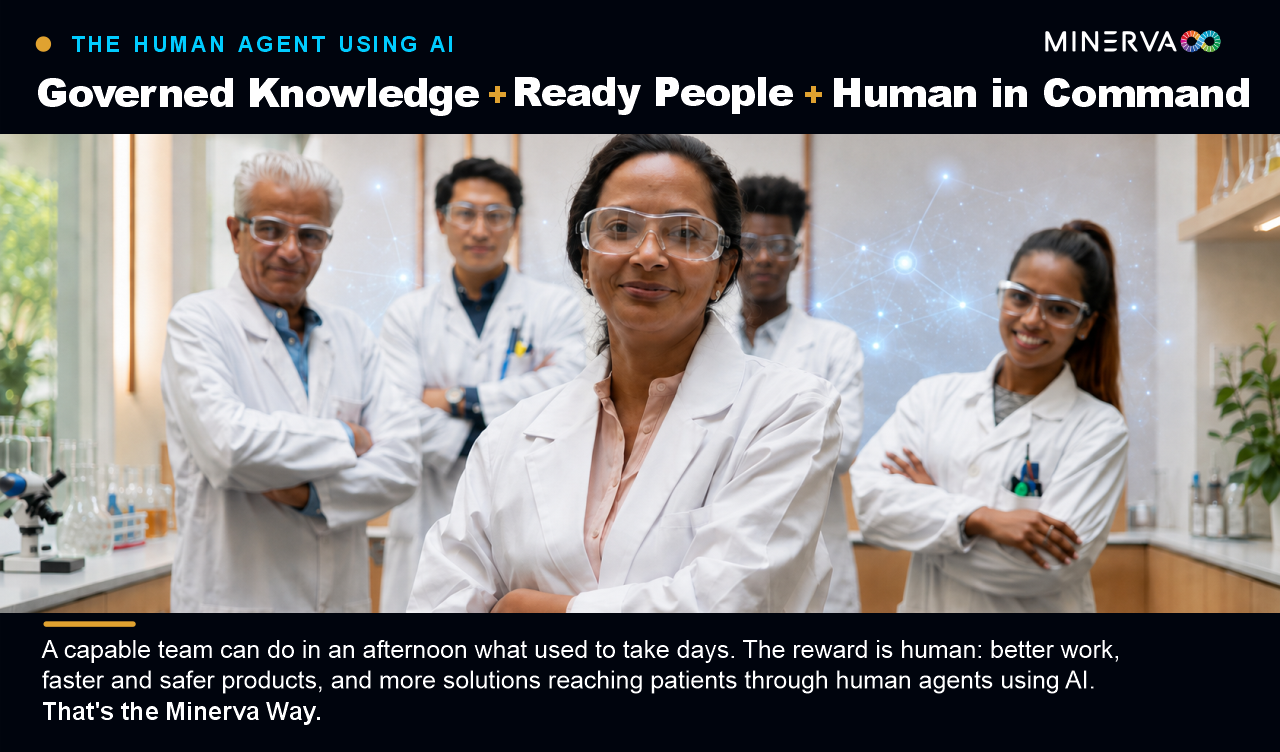
The reward is human too: better work, faster and safer products, and more solutions reaching patients because of human agents using AI.
That’s the Minerva Way.